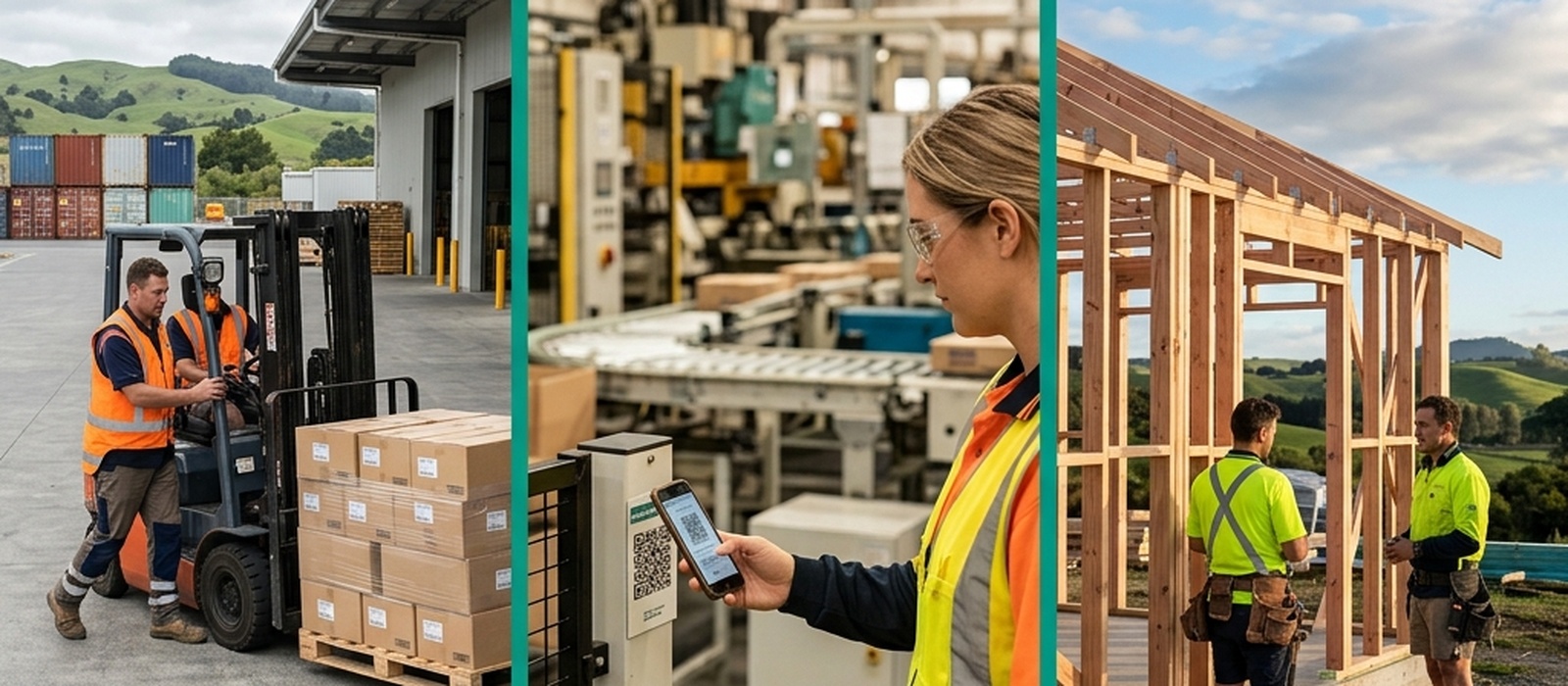
Site-access and visitor-management software is a busy category, with plenty of tools that log a visitor's name and print a sticker. Logistics operators, manufacturers and construction firms keep choosing SiteKey and adding sites to their tenancy.
We asked customers why. Few of them started with features. Most talked about running their sites with SiteKey in place, and the same four themes came up.
1. Built and supported in New Zealand
SiteKey is built and supported here in New Zealand. A site manager with a question at 7am before the gates open reaches a person who knows their setup. Changes to site access usually need to happen the same day.
We are local, so we know WorkSafe's expectations, the Health and Safety at Work Act 2015, and how New Zealand sites and contractors operate.
2. Configured for each client
We configure SiteKey to match how your sites run. A distribution centre with rolling contractor crews needs something different from a manufacturing plant with fixed shifts, or a construction site with a principal-contractor duty of care.
We build to the client. Businesses do not pay for features they will not use, and they keep their own process.
3. Teams use it from the first day
SiteKey is deliberately simple to use. Teams check workers and visitors on and off site from the first day, with no thick manual or three-week rollout.
4. One system in place of several
Businesses moving to SiteKey are usually replacing a sign-in book, a visitor tablet, a separate induction tool, spreadsheets for site walks and email chains for incidents. SiteKey puts all of it on a single auditable record, at a flat monthly price per site with no per-user or per-scan charge.
SiteKey gives you control over who is on your sites at a flat monthly price per site.
What SiteKey includes
A typical SiteKey tenancy includes:
Multi-site capability
Run every location under one login, each with its own roster and records, visible to head office in one view.
Geo-fencing & GPS check-in
Check-in and check-out use the phone's location to confirm the person is at the site.
Toolbox meetings
Record toolbox talks and attendance against the right site, ready for audit.
Live evacuation lists
See who is on site right now when you need to evacuate.
Monthly site H&S walks
Schedule and log health and safety walks with findings tracked over time.
Incident & accident reporting
Record incidents and accidents where they happen, and keep the record trail.
Email notifications
SiteKey sends managers automatic email alerts.
Contractor compliance
Site entry is blocked until a worker's inductions are current.
Pairing SiteKey with staff training
SiteKey pairs with health and safety training delivered through Capability Solutions. Businesses can make the training a condition of site access, so the people walking through the gate have done it.
The core training courses are:
- First Aid, which trains workers to respond to an injury.
- Manual Handling, which deals with the most common cause of workplace injury.
- Introduction to Health & Safety, a shared baseline for every worker.
- Forklift Awareness, on moving safely around one of the highest-risk pieces of plant on site.
The Culture Bundle adds three courses on workplace culture and shared responsibility for safety:
- Psychological Safety, on building a safe environment for communication and mental wellbeing in high-pressure industries.
- Understanding Behaviours, on workplace psychology and how to build a positive, productive team.
- Assertiveness & Conflict, with communication tools for managing tension and keeping focused on the job on site.
WorkSafe has made clear that, as well as physical hazards on site, businesses must manage psychosocial risks such as stress, fatigue, bullying and poor workplace relationships as part of their duty to provide mentally healthy work. The Culture Bundle is one way to meet that expectation. Training completion can be tied to site access in SiteKey, so a worker with current training is cleared to enter.
See SiteKey on your own sites
Tell us how your sites run and we will show you how SiteKey would be set up for your operation, with support from our team in New Zealand.
Talk to us about your sites